Bahia Palace Marrakech: The Complete 2026 Visitor Guide
Table of Contents
Bahia Palace Marrakech: The Complete 2026 Visitor Guide
Quick answer: Bahia Palace Marrakech is a late-19th-century palace complex in the medina’s Kasbah district, built for the Grand Vizier Si Moussa in 1866–67 and dramatically expanded by his son Bou Ahmed. It’s open daily, costs 70 MAD (about $7) to enter, takes 45–60 minutes to visit, and is best seen first thing in the morning before tour groups arrive. It’s one of the most complete surviving examples of 19th-century Moroccan palace architecture open to the public.
Jump to: History · Architecture · Hours & Tickets · Best Time to Visit · Bahia vs. El Badi Palace · Nearby Attractions · Is It Worth Visiting? · FAQ
Bahia Palace Marrakech is, room for room, the best-preserved 19th-century palace you can walk through in Morocco. Unlike the roofless ruins of nearby El Badi Palace, Bahia still has its carved cedar ceilings, its painted stucco, and its zellige tile floors largely intact, which is why it’s consistently ranked among the top things to do in Marrakech even though it isn’t a mosque, a souk, or a square. The complex is genuinely large — nearly 2 hectares (about 5 acres), with a Grand Courtyard alone measuring roughly 50 by 30 meters — and it remains functionally important today: the King of Morocco still uses part of the palace to receive foreign dignitaries, and published tourism figures have shown it drawing well over 400,000 visitors in a single four-month stretch, making it one of the most-visited heritage sites in the country. This guide covers what it actually is, who built it and why, exactly what you’ll see room by room, and the practical details — hours, tickets, crowds, and how to fit it into a Marrakech itinerary — that most write-ups skip.
The History of Bahia Palace Marrakech: From a Freed Slave to a Royal Vizier
Bahia Palace’s history is unusually well documented for a Moroccan monument, and it’s a genuinely remarkable story of political ambition expressed through architecture.
Si Moussa: The Palace’s Founder
The first phase of the palace was built between 1866 and 1867 by Si Moussa, the Grand Vizier (chief minister) to the reigning Sultan. Si Moussa’s own rise is part of what makes the site interesting: multiple historical accounts describe him as a former slave who climbed through the ranks of the Moroccan court to become one of the most powerful men in the kingdom. The name he gave his new residence, “Bahia,” translates roughly as “brilliance” or “beautiful,” and the palace was designed from the outset to project the wealth and taste of its owner.
Bou Ahmed: The Expansion That Created the Palace You See Today
Most of what visitors actually see today dates not from Si Moussa’s era but from his son, Bou Ahmed, who inherited the property and rose to become Grand Vizier himself, eventually serving as de facto regent of Morocco until his death in 1900. Between roughly 1894 and 1900, Bou Ahmed enlarged the palace substantially, adding the Grand Riad with its Andalusian gardens, expanding the harem quarters to house his four wives and numerous concubines, and commissioning the elaborate carved cedar ceilings and painted stucco work that define the palace’s most photographed rooms. The project was overseen by the master architect Muhammad ibn Makki al-Misfiwi, and artisans were drawn from across Morocco’s craft traditions to complete the decoration, which is one reason the palace reads almost like a showcase of the country’s finest architectural techniques in one place. By the time Bou Ahmed died, the complex covered nearly 2 hectares (about 5 acres) and contained roughly 150 rooms arranged around courtyards and gardens.
Bou Ahmed’s own biography is part of what makes the palace worth understanding rather than just photographing. He inherited his father’s court position but built his real power independently, eventually becoming regent for the young Sultan Abdelaziz and, for a period, the most powerful unelected figure in Morocco. Contemporary accounts describe him as shrewd, feared, and deeply image-conscious — qualities that show up directly in the palace’s design. Nearly every decision, from the oversized Grand Courtyard to the sheer number of harem apartments, reads as a statement of status rather than a purely practical living arrangement. That’s worth keeping in mind as you walk through: Bahia Palace wasn’t built primarily as a home, it was built as a message.
Ransacked, Occupied, and Reopened as a Museum
The palace’s fortunes changed abruptly after Bou Ahmed’s death in 1900. Because he had accumulated his position and his wealth through political maneuvering rather than inheritance, the palace was ransacked shortly after he died, with furnishings, carpets, and valuables removed by rivals and the sultan’s court. When the French protectorate formally began in 1912, the Resident-General took up residence in part of the complex, and the building later served for a time as a residence for King Mohammed V before being converted for administrative, ceremonial, and museum use. Today, Bahia Palace is protected as part of the Medina of Marrakesh UNESCO World Heritage Site, inscribed in 1985, and part of it is still used by the King of Morocco to formally receive foreign dignitaries — a working royal building as much as a historical one.
The 2023 Earthquake and Today’s Palace
Bahia Palace sustained damage in the powerful earthquake that struck the High Atlas region in September 2023, along with several other historic sites across Marrakech’s medina. Restoration work followed quickly, and the palace reopened to visitors the following month, in October 2023. It’s worth knowing this if you’ve read older trip reports or forum posts referencing closures — as of this guide’s publication, Bahia Palace is fully open to the public on its normal daily schedule.
Bahia Palace Architecture: What You’ll Actually See
Bahia Palace’s architecture is a working catalogue of the core techniques of Moroccan decorative craft: zellige tilework, carved and painted stucco, and carved cedar wood, arranged around a sequence of courtyards and gardens rather than a single continuous building.
The Grand Courtyard (Cour d’Honneur)
The palace’s largest open space is paved in white marble and ringed by covered galleries supported on carved columns. It’s the closest thing the palace has to a formal reception space, and its scale — large enough that it reads as a small public square rather than a private courtyard — is meant to communicate Bou Ahmed’s status to visiting dignitaries.
The Grand Riad and Andalusian Gardens
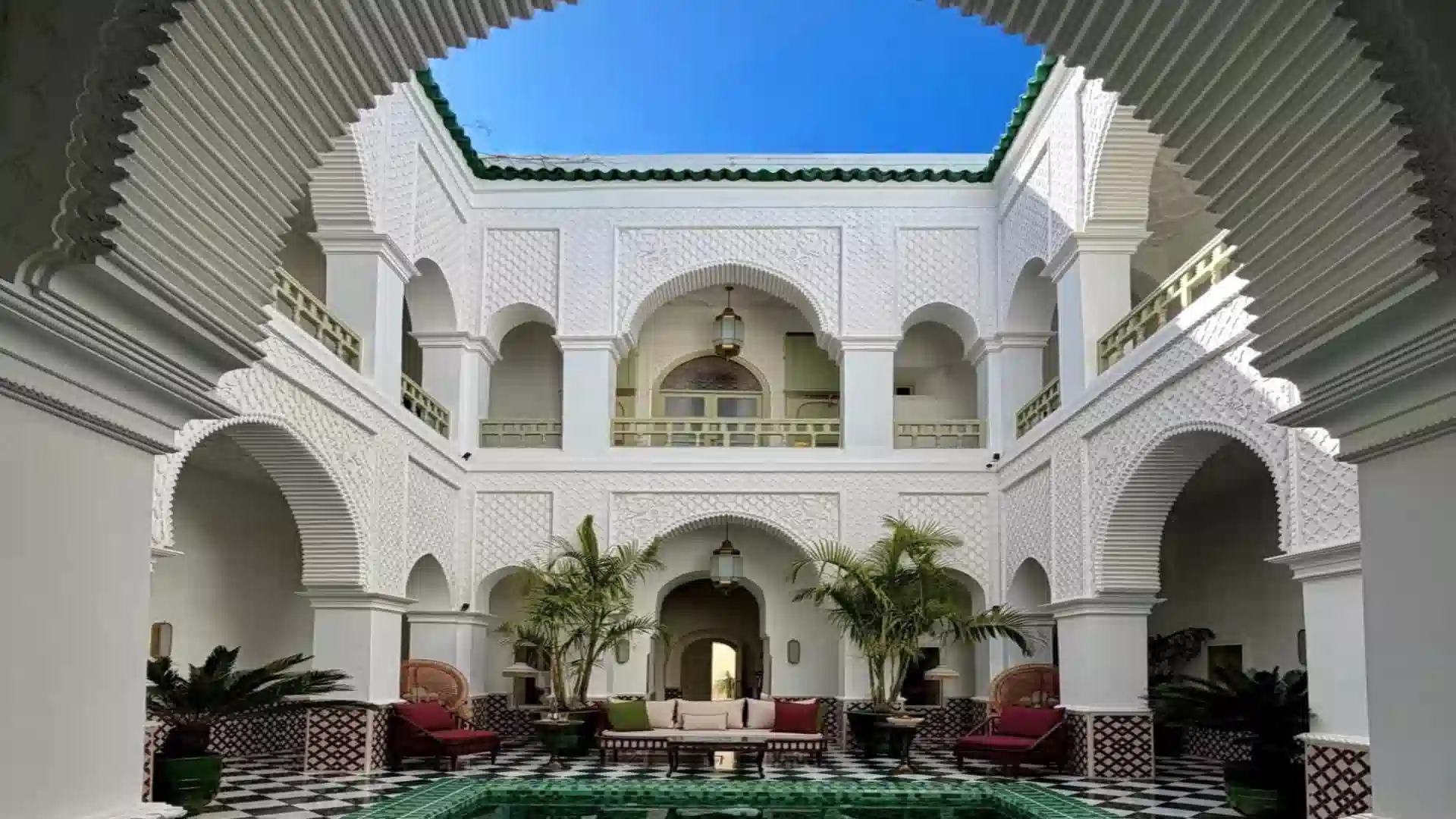
Beyond the main courtyard, the Grand Riad centers on a large basin surrounded by four garden quadrants planted in the Andalusian tradition: cypress, banana trees, jasmine, and citrus arranged around water and pathways, a layout meant to evoke paradise gardens described in Islamic tradition. The four-part division around a central water feature is a deliberate echo of the “chahar bagh” (four-garden) layout found across Islamic architecture from Spain to South Asia, and it’s one of the clearest examples in Marrakech of how thoroughly Moroccan palace design borrowed from and contributed to that wider tradition. This is one of the palace’s most peaceful corners and a good spot to slow down rather than move straight through — the sound of running water and the shade of mature trees make it a natural break point partway through a visit, especially in the warmer months.
The Salon d’Honneur and Painted Cedar Ceilings
The palace’s most photographed room is arguably the Salon d’Honneur, where carved and painted cedar wood ceilings rise above walls finished in intricately carved stucco. The ceiling work in particular represents months of specialist labor — carved by hand, then painted in mineral pigments — and remains in remarkably original condition compared to similar rooms elsewhere in Morocco.
Zellige Tilework Throughout
Floors and lower wall panels throughout the complex are finished in zellige — small, individually hand-cut glazed tiles assembled into geometric mosaics. Traditionally, each tile is cut by hand from a larger glazed ceramic slab using a small hammer and chisel, then fitted into a pattern from the back, face-down, so the finished mosaic emerges only once the whole panel is flipped and set into plaster. It’s a slow, specialist craft historically associated with Fes as much as Marrakech, and the fact that Bahia Palace could commission this quality of work throughout an entire complex, rather than a single showcase room, says something about the resources Bou Ahmed had at his disposal. Each courtyard here uses a slightly different palette and pattern, and tracing the variation from room to room is one of the more rewarding ways to slow your visit down.
The Harem Quarters
Adjacent to the Cour d’Honneur sits the harem section, the private quarters that housed Bou Ahmed’s wives and concubines. The rooms here are smaller and more intimate than the palace’s public spaces, with painted wooden ceilings and stucco work that, while less monumental than the Salon d’Honneur, is arguably more delicate. Historical accounts note that Bou Ahmed’s favorite wife, Lalla Zineb, had her own dedicated apartment within this section, distinct from the others in both size and decoration — a detail that gives the harem quarters a more human, specific texture than the “generic royal household” framing they sometimes get in shorter write-ups. Walking through these rooms after the grandeur of the Cour d’Honneur and Grand Riad is a useful reminder that the palace was, underneath the political statement-making, still someone’s home.
| Feature | What to Look For | Where |
|---|---|---|
| Zellige tilework | Geometric hand-cut tile mosaics, different pattern per room | Throughout, especially courtyard floors |
| Carved stucco | Calligraphic and floral motifs carved into plaster | Salon d’Honneur, harem quarters |
| Painted cedar ceilings | Hand-carved wood, painted in mineral pigments | Salon d’Honneur |
| Marble courtyard | White marble paving, carved column galleries | Cour d’Honneur (Grand Courtyard) |
| Andalusian gardens | Cypress, banana, jasmine and citrus around a central basin | Grand Riad |
A Room-by-Room Walking Route Through Bahia Palace
Because Bahia Palace has no single obvious circuit and its courtyards connect in a slightly maze-like way, it helps to know roughly what order things unfold in. Most visitors follow a version of this sequence:
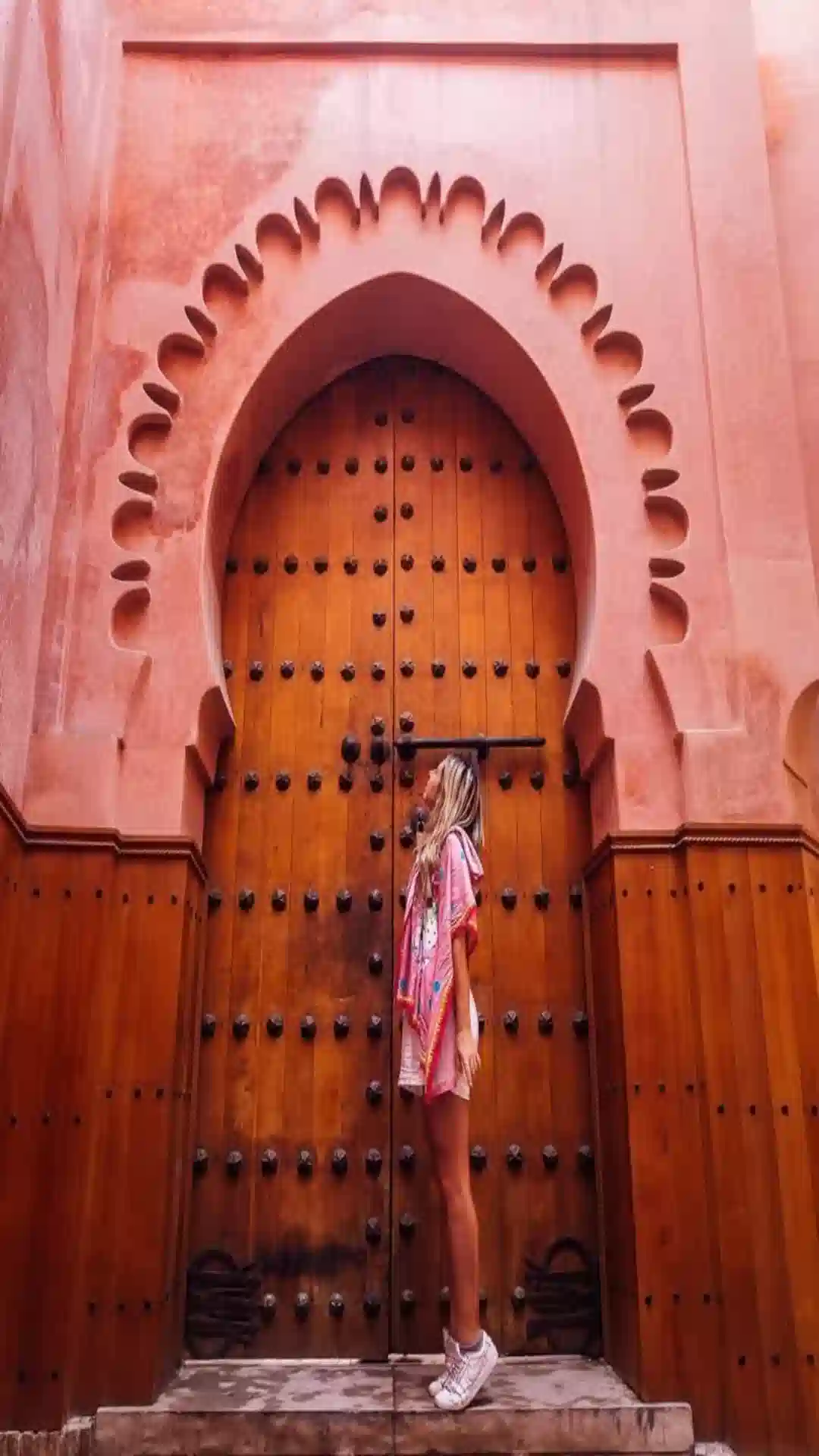
- The entrance corridor. A relatively plain horseshoe-arch doorway from the street gives little hint of what’s inside — a deliberate contrast that makes the first courtyard feel more dramatic.
- The small riad (Petite Cour). An intimate courtyard with a modest fountain, often the first real display of zellige tile and carved stucco, and a good place to slow your pace before the larger spaces.
- The Grand Courtyard (Cour d’Honneur). The palace’s showpiece open space, with its white marble paving and column galleries — this is usually where you’ll first notice the scale Bou Ahmed was going for.
- The Grand Riad. The garden courtyard with its central basin and four planted quadrants, a shift in mood from stone and tile to greenery and running water.
- The harem quarters. A cluster of smaller private rooms off the main courtyards, each with slightly different stucco and ceiling detail, reflecting the individual apartments of Bou Ahmed’s wives and concubines.
- The Salon d’Honneur. Usually visited last or near-last, and worth saving — the painted cedar ceiling here is the single most elaborate piece of woodwork in the complex.
Signage inside is limited, which is the main reason a licensed guide adds real value here beyond convenience — without one, it’s easy to walk past details (a particular carved motif, a room’s original function) that make the palace click as more than “pretty tiles.”
Bahia Palace in the Context of Morocco’s Palace Architecture
Bahia Palace is easier to appreciate once you see it as part of a wider Moroccan tradition rather than a one-off. The same core techniques — zellige tilework, carved and painted stucco, carved cedar ceilings — appear across the country’s great historic buildings, from the madrasas of Fes to the palaces of Meknes and Rabat, but the specific combination and quality on display at Bahia Palace place it among the finest surviving 19th-century examples of the style. If you’ve already visited or plan to visit Fes, the family resemblance to the woodwork in the Bou Inania Madrasa or the Fes medina’s grand riads is genuinely striking — different city, different century in some cases, but the same underlying craft vocabulary. For a broader look at how this architectural tradition shows up across Morocco’s historic royal capitals, see our guide to Morocco’s Imperial Cities: Fes, Marrakech, Meknes & Rabat.
| Landmark | City | Best Comparison Point to Bahia Palace |
|---|---|---|
| Bou Inania Madrasa | Fes | Comparable carved stucco and cedar woodwork, religious rather than residential context |
| Royal Palace exteriors | Fes & Meknes | Similar monumental gates and courtyard planning principles |
| El Badi Palace | Marrakech | Same city, same royal-display purpose, now in ruins rather than intact |
| Saadian Tombs | Marrakech | Comparable density of tilework and carved decoration, smaller scale |
Visiting Bahia Palace Marrakech: Hours, Tickets & Practical Information
Bahia Palace is open every day of the week, which makes it one of the more reliably accessible monuments in the Marrakech medina.
| Detail | Information |
|---|---|
| Opening hours | Typically 8:30am–5:00pm daily (hours can shift slightly by season and around Friday prayers — confirm on arrival) |
| Entrance fee | Approximately 70 MAD (around $7 USD) for general admission |
| Average visit length | 45–60 minutes |
| Guided tours | Available on-site; a licensed guide adds historical context the signage doesn’t provide |
| Accessibility | Mostly ground-level courtyards, but some uneven stone flooring and doorway thresholds |
| Photography | Generally permitted for personal use; tripods may require separate permission |
Bring cash in dirhams for the entrance fee, wear comfortable shoes since the visit is almost entirely on foot across stone and tile flooring, and budget extra time if you’re visiting with a guide who wants to explain the history room by room rather than just pointing you through.
How to Get to Bahia Palace
Bahia Palace sits at 5 Derb el Arsa, Riad Zitoun el Jdid, in the Kasbah district of Marrakech’s medina, roughly a 15–20 minute walk southeast of Jemaa el-Fna square. Most visitors either walk in via the Riad Zitoun el Jdid street (following signs and, often, a stream of other tourists headed the same way), take a petit taxi directly to the palace entrance for a few dirhams, or arrange a horse-drawn calèche for a more scenic approach through the Kasbah. If you’re staying in a riad inside the medina, walking is usually the simplest option; if you’re based in the Gueliz (new town) area, a taxi is faster and inexpensive.
What to Wear and Bring
Modest clothing (shoulders and knees covered) is respectful and practical here, since much of the visit is outdoors in direct sun with limited shade. Comfortable, flat shoes matter more than they might seem to, since the courtyards mix smooth marble, rougher stone, and the occasional raised threshold, and there’s more total walking distance than the palace’s compact footprint on a map might suggest once you factor in backtracking through connecting corridors. Bring small-denomination dirhams for the entrance fee and for tipping a guide if you use one, a hat and water in warmer months, and a camera or phone with some storage free — the tilework and ceilings are genuinely photogenic, and most visitors end up taking far more photos than planned.
Best Time to Visit Bahia Palace
The best time to visit Bahia Palace is right at opening, around 8:30–9:00am, before the large coach tour groups arrive mid-morning. The palace’s courtyards are compact enough that a handful of tour groups moving through at once can make the space feel considerably more crowded than its size suggests, and photography without dozens of other visitors in frame becomes far harder after about 10am. A second, quieter window opens in the late afternoon, roughly an hour or two before closing, once day-tour groups have moved on to their next stop. Visiting in the cooler months (October through April) also means the open-air courtyards are pleasant to linger in, whereas the marble and stone surfaces can get uncomfortably hot to the touch during Marrakech’s peak summer months.
Bahia Palace vs. El Badi Palace: Which Should You Visit?
Visitors with limited time in Marrakech often ask whether to prioritize Bahia Palace or the nearby El Badi Palace, and the honest answer is that they show you two different things.
| Bahia Palace | El Badi Palace | |
|---|---|---|
| Condition | Largely intact — original tilework, stucco and ceilings | Ruined — mostly bare walls and storks nesting on the ramparts |
| Built | 1866–1900 | 1578 (Saadian era), demolished for materials in the 1600s |
| Best for | Seeing genuine Moroccan decorative craftsmanship up close | Atmosphere, scale, and rooftop views over the ruins |
| Typical visit time | 45–60 minutes | 30–45 minutes |
If you can only visit one, Bahia Palace gives you a far clearer sense of what a functioning Moroccan royal residence actually looked like, decorated and complete. If you have time for both — and they’re a short walk apart — El Badi’s stripped-down grandeur makes an effective contrast right afterward.
Nearby Attractions: How to Combine Your Visit
Bahia Palace sits in Marrakech’s Kasbah district, within easy walking distance of several other major sites, which makes it easy to build into a half-day southern medina route rather than visiting in isolation.
- El Badi Palace — roughly a 10-minute walk; the ruined 16th-century counterpart to Bahia’s intact grandeur, built by the Saadian sultan Ahmad al-Mansur and later stripped for building materials, leaving dramatic bare walls, sunken orange-tree gardens, and storks nesting on the ramparts.
- Saadian Tombs — a similarly short walk; the ornate 16th-century royal necropolis rediscovered only in 1917, another must-see for the same architectural period as El Badi, and famous for its own dense zellige and marble work in a much smaller space.
- The Mellah (former Jewish Quarter) — directly adjacent to the palace; worth a wander for its distinct architecture, tighter street grid, and the Lazama Synagogue, one of the few active reminders of Marrakech’s once-substantial Jewish community.
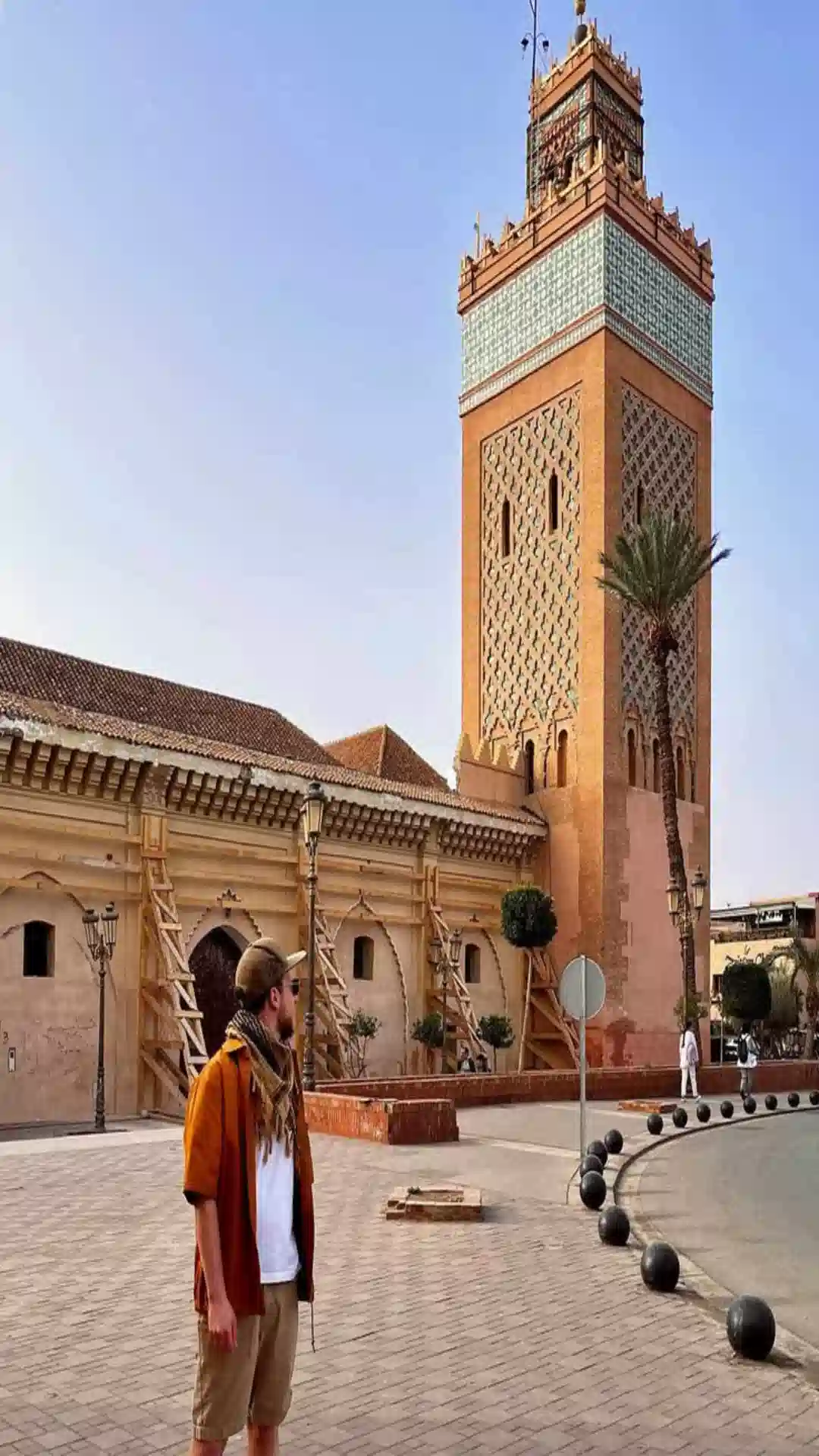
- Kasbah Mosque — a few minutes away, an active mosque with a striking minaret (viewable from outside, since non-Muslims cannot enter working mosques in Morocco).
A logical half-day route is Bahia Palace in the morning, followed by the Mellah, then El Badi Palace and the Saadian Tombs, finishing with lunch back toward Jemaa el-Fna. For the rest of Marrakech’s essential sights beyond this district, see our guide to 25 Best Things to Do in Marrakech.
Tips for Getting the Most Out of Your Bahia Palace Visit
- Go early or go late. As covered above, this single decision affects your experience more than anything else on this list.
- Hire a licensed guide at the entrance, or book one in advance. The palace’s minimal signage means most of the historical context — who lived in which room, what a specific motif represents — is invisible without one.
- Look up as often as you look around. The ceilings, particularly in the Salon d’Honneur and harem rooms, are where the most detailed craftsmanship is concentrated, and it’s easy to miss them while focused on the tilework at eye level.
- Don’t rush the Grand Riad. Most visitors treat the garden courtyard as a walkway between the “real” rooms; it’s actually one of the more atmospheric parts of the whole complex if you pause in it.
- Pair it with El Badi Palace and the Saadian Tombs the same morning. All three are close enough together, and different enough from each other, that splitting them across separate days usually isn’t necessary.
- Carry small bills. Larger notes can be difficult to break at the ticket window during busy periods.
Is Bahia Palace Worth Visiting?
Yes — Bahia Palace is worth visiting for almost anyone spending more than a day in Marrakech, and it’s one of the best answers to “what does authentic Moroccan palace architecture actually look like” that the city offers at an accessible price point. It rewards travelers with even a passing interest in architecture, craftsmanship, or Moroccan history far more than its modest entrance fee and short visit time would suggest, and at roughly $7 for up to an hour inside a genuinely significant historic building, it’s one of the better value stops in the entire medina. Where it’s less essential is for travelers on an extremely tight schedule who have to choose between it and Marrakech’s true headline sights — the Koutoubia Mosque, Jemaa el-Fna, and the Majorelle Garden — since those remain the higher priority if you truly only have one day. If you have two days or more, though, there’s little reason to skip it: it slots naturally into a southern-medina morning alongside El Badi Palace and the Saadian Tombs without requiring a special trip of its own. For a broader view of whether Marrakech itself justifies a stop on your Morocco trip, see Is Marrakech Worth Visiting? An Honest 2026 Guide.
Frequently Asked Questions
What is Bahia Palace known for?
Bahia Palace is known for being one of the best-preserved examples of 19th-century Moroccan palace architecture, with intact zellige tilework, carved stucco, and painted cedar ceilings across a sequence of courtyards and gardens built for the Grand Vizier Bou Ahmed between 1894 and 1900. It’s also still functionally significant today, since part of the complex continues to be used by the King of Morocco for official receptions.
How much does it cost to enter Bahia Palace?
General admission to Bahia Palace costs approximately 70 MAD (around $7 USD) per person, payable in cash in dirhams at the entrance. There is no separate online booking system for individual tickets; guided tours are arranged separately, either on-site or in advance through a tour operator.
How long does it take to visit Bahia Palace?
Most visitors need 45 to 60 minutes to see Bahia Palace at a comfortable pace, following the courtyards and rooms from the entrance corridor through to the Salon d’Honneur; a guided tour that explains the history room by room can take closer to 90 minutes.
Is Bahia Palace better than El Badi Palace?
Bahia Palace and El Badi Palace serve different purposes — Bahia shows you an intact, decorated royal residence built in the 1890s, while El Badi offers dramatic 16th-century ruins and rooftop views over a sunken garden — and many visitors find the two worth seeing together rather than choosing one over the other, especially since they’re only about a 10-minute walk apart.
What is the best time of day to visit Bahia Palace?
The best time to visit Bahia Palace is right at opening (around 8:30–9:00am) or in the last hour or two before closing, both of which avoid the mid-morning tour bus crowds that can make the courtyards feel considerably more crowded than their size suggests.
Plan Your Marrakech Visit with Over Morocco Tours
Bahia Palace is one of the easiest highlights to build into any Marrakech stay, whether you’re spending a single day in the city before heading to the Sahara or basing yourself here for several nights. Our Marrakech-based itineraries can arrange a private guide for Bahia Palace, El Badi Palace, and the Saadian Tombs as part of a half-day city tour, timed to start before the crowds arrive. It also pairs naturally with a longer circuit: many of our multi-day desert tours begin or end in Marrakech with a free morning or afternoon that’s tailor-made for exactly this kind of city sightseeing before or after the Sahara.
Related Guides
- Things to Do in Marrakech: 25 Best Attractions & Activities
- Is Marrakech Worth Visiting? An Honest 2026 Guide
- Djemaa el Fna Marrakech: Complete Visitor Guide
- Majorelle Garden Marrakech: Complete Visitor Guide
- Morocco’s Imperial Cities: The Complete Guide
Sources referenced: the UNESCO World Heritage Centre listing for the Medina of Marrakesh, Wikipedia’s entry on the palace’s history and dimensions, and published visitor and historical information from Bahia Palace’s official visitor information pages. Hours and prices can change seasonally, so always confirm current details before you visit Bahia Palace Marrakech.