Marrakech to Merzouga: Distance, Closest Airport, Safety & the Best 2-Day Plan (2026)
Table of Contents
Marrakech to Merzouga: Distance, Closest Airport, Safety & the Best 2-Day Plan (2026)
Quick answer: Marrakech to Merzouga is about 560 km (350 miles) and takes 9–10 hours by road, since no direct flight or train serves the Sahara. Most travelers cover it as a 2-to-3-day guided loop rather than a straight drive, sleeping in Merzouga’s Erg Chebbi dunes before returning. The closest airport is Errachidia (126 km, roughly 2 hours away), though almost all international visitors still fly into Marrakech. Yes, it’s worth visiting, and yes, the desert itself is safe for tourists.
If you’re based in Marrakech and wondering whether the trip out to Merzouga’s Sahara dunes is worth the drive, this guide answers the questions that actually come up when people plan it: how far it is and how you get there, which airport is genuinely closest, whether two days is enough, what there is to do once you arrive, and whether the desert is safe. It also settles a common point of confusion — Merzouga isn’t the only “desert near Marrakech,” and knowing the difference will change how you plan the trip.
This route is, by a wide margin, the single most-requested addition to a Morocco itinerary among travelers who start their trip in Marrakech, and it’s also the one that generates the most last-minute planning questions — usually because people assume it works like a day trip and only discover the real distances once they start looking at a map. Everything below is based on the route we run ourselves, day in and day out, from a base in Merzouga itself.
How Do You Get from Marrakech to Merzouga?
There’s no flight, train, or direct highway shortcut: getting from Marrakech to Merzouga means a 9–10 hour road journey across the High Atlas Mountains, and nearly everyone splits it into two or three days rather than driving it in one push.
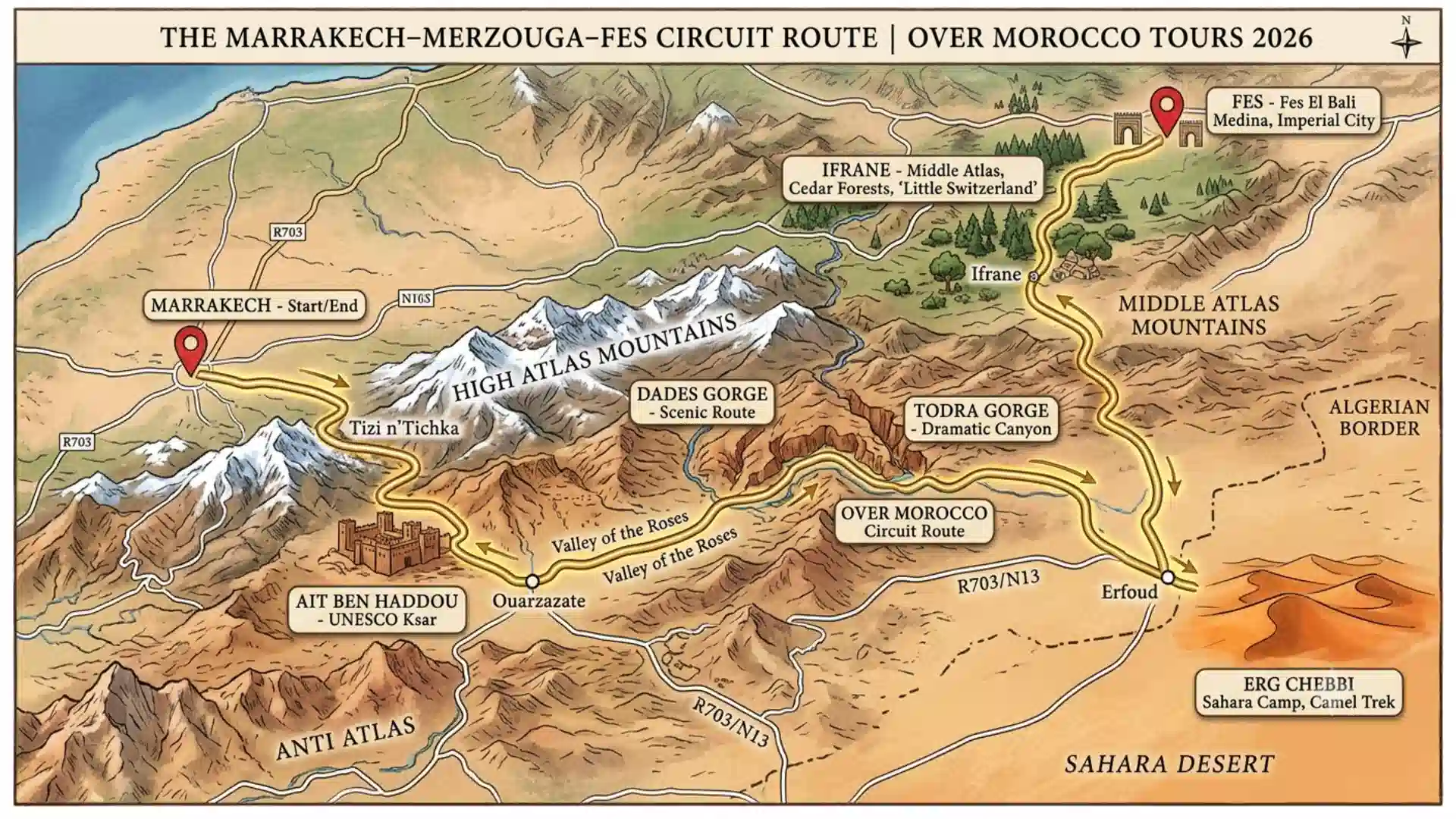
Some travelers also ask whether it’s worth doing the trip as a one-way loop instead of a round trip back to Marrakech — continuing north from Merzouga to Fes rather than returning the way you came. It’s a genuinely good option if your onward flight or next stop is in the north: the route via the Ziz Valley and Middle Atlas cedar forests to Fes is a different, greener landscape than the Marrakech-side drive, and it means you’re not retracing the same road twice.
Distance and Driving Time
The route covers roughly 560 km (350 miles) and climbs over the Tizi n’Tichka pass (2,260 meters) before dropping through Ouarzazate, the Dades and Todra Gorges, and Erfoud to reach Merzouga on the edge of the Erg Chebbi dunes. Driven non-stop, it’s a 9–10 hour drive, but the mountain switchbacks, gorge scenery, and worthwhile stops along the way (Ait Ben Haddou’s UNESCO kasbah in particular) mean almost no one actually drives it straight through.
Your Transport Options
- Private driver-guide (most popular with tourists): A private 4×4 or minivan with an English-speaking driver-guide, typically as part of a 2-to-4-day tour package that includes stops, meals, and the desert camp. This is the most comfortable and flexible option and the one we run daily from Marrakech.
- Shared small-group tour: The same route on a fixed schedule with 6–16 other travelers, at a lower per-person cost. Widely available as 3-day and 4-day packages.
- CTM or Supratours bus: Public buses run from Marrakech toward Rissani/Merzouga, but the journey takes 12+ hours with connections, and you’ll still need a local transfer for the final stretch into the dunes and a camel trek to reach camp. It’s the cheapest option and the least practical for most visitors.
- Self-drive rental car: Possible, but the Tizi n’Tichka pass involves genuine mountain driving (fog, occasional winter snow, slow trucks on blind curves), and the last stretch into the Erg Chebbi dunes requires local knowledge to avoid getting stuck in sand. Most self-drive travelers still book a local guide for the final desert leg.
For most first-time visitors, a private or shared multi-day tour beats the alternatives on every axis that matters: it turns 9 hours of driving into a scenic, guided journey rather than a chore, and it includes the camel trek and desert camp you’d otherwise have to arrange separately once you arrive.
| Option | Approx. Cost (per person) | Comfort | Best For |
|---|---|---|---|
| Private driver-guide, 3-day tour | $250–$400 | High — your own vehicle and pace | Couples, families, comfort-first travelers |
| Shared small-group, 3-day tour | $120–$180 | Moderate — fixed group schedule | Solo travelers, budget-conscious groups |
| CTM/Supratours bus + local transfer | $30–$50 | Low — long hours, multiple connections | Backpackers with flexible time and no interest in stops en route |
| Self-drive rental car | $40–$70/day (car only) | Variable — depends on driving experience | Confident mountain drivers wanting full independence |
These figures cover transport, a driver-guide where applicable, and standard desert camp accommodation on tour packages; the bus and self-drive options don’t include a guide or camp booking, which you’d need to arrange separately once you reach Merzouga. For a full breakdown of what’s included at each price tier, see Morocco Desert Tour Cost: What You Actually Pay in 2026.
What Is the Closest Airport to Merzouga?
Errachidia Airport (ERH) is the geographically closest airport to Merzouga at about 126 km (2 hours by road), but Marrakech Menara (RAK) remains the most practical choice for almost all international travelers because of its far greater flight frequency.
This is a genuinely common point of confusion when people search “closest airport to Merzouga” hoping to shortcut the drive: the closest airport on a map isn’t the same as the most useful one to actually fly into. Errachidia’s limited domestic schedule means building a trip around it usually adds a connection through Casablanca and still leaves you arranging local transport for the final stretch — often with less flexibility than simply booking the well-established Marrakech route.
| Airport | Distance to Merzouga | Drive Time | Flight Frequency |
|---|---|---|---|
| Errachidia (ERH) | 126 km | ~2 hours | Limited — a handful of domestic routes from Casablanca/Marrakech |
| Ouarzazate (OZZ) | 365 km | ~5 hours | Low — seasonal and infrequent |
| Fes (FEZ) | 455 km | ~7 hours | Good — regular domestic and some international routes |
| Marrakech (RAK) | 562 km | 9–10 hours | Excellent — high-frequency domestic and international flights year-round |
In practice, almost nobody flies into Errachidia purely to save driving time, since its limited schedule rarely lines up with international connections and it isn’t served by the major carriers most Americans and Europeans book. The standard, reliable pattern is to fly into Marrakech (or Fes, if you’re doing a one-way Marrakech-to-Fes desert circuit) and treat the road journey to Merzouga as part of the trip rather than a logistics problem to route around.
There’s a second reason Marrakech wins out even though it’s the furthest option on paper: the drive itself passes through some of Morocco’s best scenery, and starting from a smaller regional airport would mean missing the Tizi n’Tichka pass, Ait Ben Haddou, and the gorges entirely, or adding a separate detour to see them anyway. Travelers who’ve tried routing through Ouarzazate specifically to shorten the drive generally report it wasn’t worth the extra flight connection and cost once they factored in Ouarzazate’s thinner flight schedule and the fact that they still wanted to see Ait Ben Haddou, which sits between Marrakech and Ouarzazate regardless of which airport you use.
Can You Plan a 2-Day Trip to Merzouga from Marrakech?
Yes, a 2-day Marrakech-to-Merzouga trip is possible and reasonably popular for travelers short on time, but it’s a compressed version of the experience: expect two long driving days bookending a single desert night, with far less time at each stop than the standard 3-day version.
Sample 2-Day Itinerary
- Day 1: Early departure from Marrakech (ideally by 7–8 AM), cross the Tizi n’Tichka pass with a short photo stop, visit Ait Ben Haddou’s kasbah, continue through the Dades Valley, and press on to Merzouga by early evening for a camel trek into the dunes and an overnight Berber camp.
- Day 2: Sunrise over Erg Chebbi, camel ride or 4×4 back to the village, breakfast, then the full drive back to Marrakech, typically arriving by early evening.
The honest tradeoff: a 2-day trip gets you the headline experience — one night in the Sahara — but with almost no slack for the Dades and Todra Gorges, and two genuinely long days in the vehicle (roughly 8–9 hours of driving each way). If your schedule allows even one extra day, a 3-day version splits the outbound drive into two shorter days, adds proper time at the gorges, and is consistently the better-reviewed option. Treat the 2-day trip as a “make it work” option for a tight schedule, not the ideal way to see the route.
If you do go with the 2-day version, a few adjustments make it noticeably more comfortable: start as early as your riad’s checkout allows (aim for 7 AM rather than 8 or 9), pack a proper breakfast or snacks for the road since stops become brief, and confirm with your operator in advance that the itinerary is genuinely built as a 2-day loop rather than a 3-day tour compressed at the last minute — the difference shows up in how rushed the gorge stops feel. Bring layers for the desert camp regardless of the season, since even a single overnight doesn’t spare you the temperature swing after sunset.
Is Merzouga Worth Visiting?
Yes — Merzouga is worth visiting for the Erg Chebbi dune field alone, which at up to 150 meters high is the tallest and most photographed dune system in Morocco, and for the experience of an overnight desert camp that’s genuinely hard to replicate anywhere else within a day’s reach of Marrakech.
Reasons it consistently earns the long drive:
- Erg Chebbi’s dunes are the real Sahara — not the rocky Agafay desert near Marrakech, but genuine wind-sculpted sand dunes stretching 22 km.
- A camel trek at sunset followed by a Berber camp dinner under a sky with essentially no light pollution is, for most first-time visitors, the single most memorable night of a Morocco trip.
- The drive itself is a destination: the Tizi n’Tichka pass, Ait Ben Haddou’s UNESCO kasbah, and the Dades and Todra Gorges are major sights in their own right, not just a means to an end.
- Merzouga village adds context beyond the dunes — Khamlia’s Gnawa music, the flamingos at Dayet Srji, and the fossil trade around Erfoud and Rissani.
Who might skip it: travelers with fewer than 5–6 total days in Morocco, since the round trip alone eats 2–3 days; anyone with a serious sensitivity to long car travel or extreme heat in summer; and those who’ve already done a comparable Sahara dune experience elsewhere and are looking for something different rather than repeating it. For everyone else, it’s the single most-requested addition to a Morocco itinerary for a reason.
It’s worth being specific about what “worth it” means here, since the honest answer depends on what you’re comparing it to. Against a day spent entirely in Marrakech, Merzouga wins easily — nothing in the city replicates a night under a truly dark sky on open dunes. Against skipping Morocco’s desert altogether and spending the saved days on the coast or in the Imperial Cities, it’s a closer call, and the right answer depends on how much you value one dramatic, once-per-trip experience versus more time spent at a slower pace in fewer places. Most travelers who’ve done both report that the desert night is the one part of the trip that photos and stories don’t fully capture — everyone we’ve guided out there says some version of “the pictures don’t do it justice.”
Is the Merzouga Desert Safe?
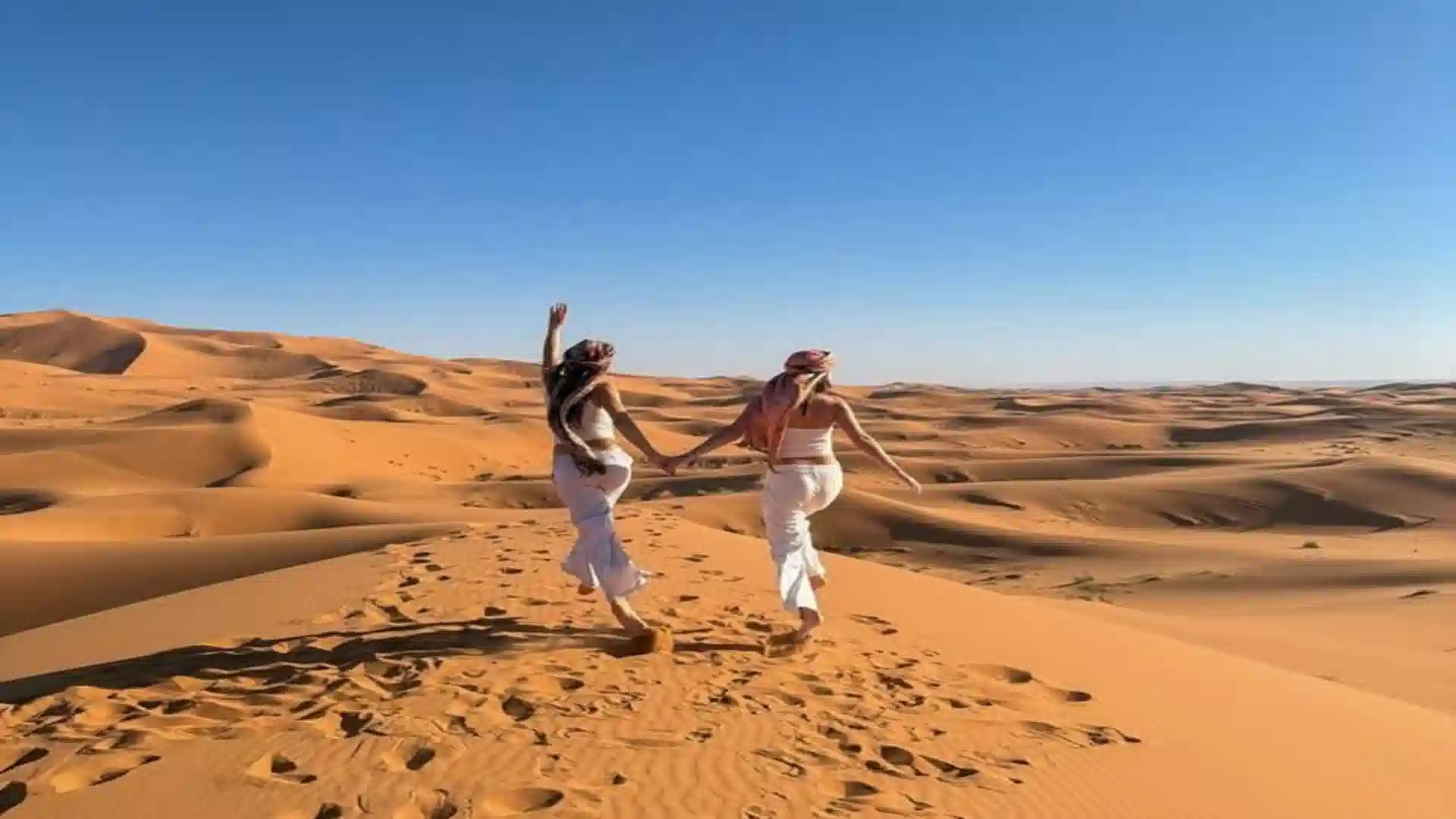
Yes, the Merzouga desert is safe for tourists. The real risks are environmental rather than about crime — extreme daytime heat in summer, cold desert nights in winter, and the practical challenges of a remote location — not personal safety.
- Heat: Summer daytime temperatures regularly exceed 100°F (38°C). Avoid strenuous activity between 11 AM and 4 PM from June through August, and carry more water than feels necessary.
- Cold nights: Desert temperatures can drop 40°F (22°C) or more after dark, even in spring and fall. Pack real layers, not just summer clothes, whatever the daytime forecast says.
- Navigation: The dunes are disorienting and genuinely easy to get lost in on foot after dark. Stay with your guide and camp group rather than wandering off to “find a quiet spot” for photos.
- Camp and operator quality: The bigger practical risk is booking with an unlicensed or poorly run operator, not the desert itself. Confirm your driver-guide is licensed and your camp booking is confirmed in writing before you go.
- General crime: Violent crime against tourists in the Merzouga area is rare. The more common nuisances are the same low-level tourist scams found across Morocco (unsolicited “guides,” inflated souvenir prices), which are easily avoided by booking transport and camps through a vetted operator.
For the country-wide picture beyond Merzouga specifically, see our guide to Is Morocco Safe to Visit in 2026?
What to Pack for the Marrakech to Merzouga Trip
Because this route crosses three distinct climates in one journey — Marrakech’s city heat, the cool High Atlas pass, and the desert’s day-night temperature swing — packing for one climate is the single most common preparation mistake. Bring layers you can add and remove throughout the day: a light, breathable outfit for daytime desert heat, a warm layer (fleece or jacket) for the evening and overnight camp, a scarf or shemagh for sand and sun protection on camel treks, closed-toe shoes for walking on the dunes and gorges, and a headlamp or flashlight, since desert camps generally run on generator power for only part of the evening. For the complete packing breakdown by season, see What to Pack for Merzouga Desert: The Ultimate Sahara Packing List.
Fun Things to Do in Merzouga
Beyond the camel trek and overnight camp, Merzouga offers a genuine range of activities worth building extra time for if your schedule allows it.
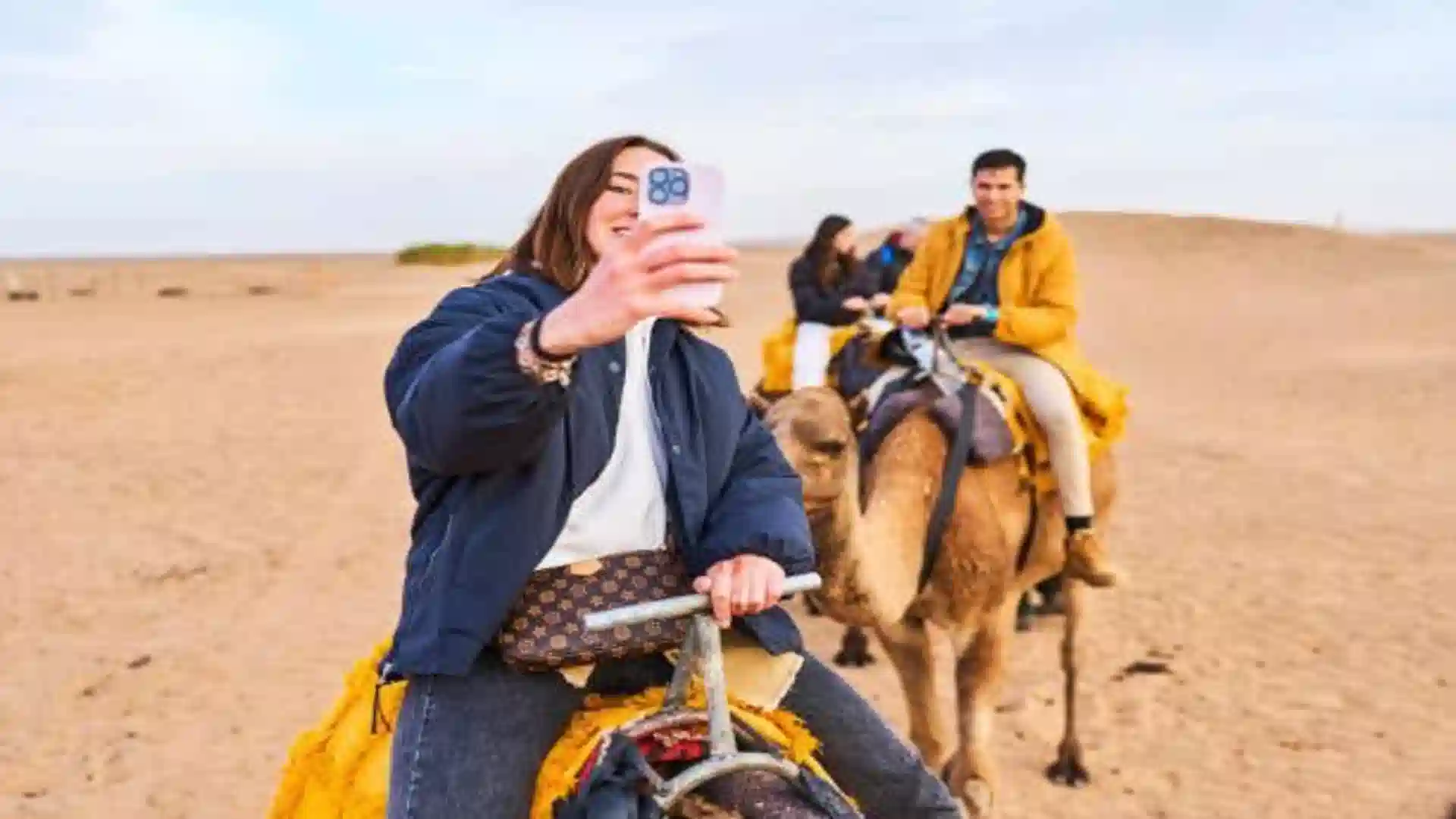
- Sunrise over Erg Chebbi: Almost universally named the highlight of the whole trip. Most camps wake guests around 5:30 AM for a short camel or 4×4 ride to a dune crest, where the pre-dawn light turns the sand shades of pink and gold that don’t show up at any other hour.
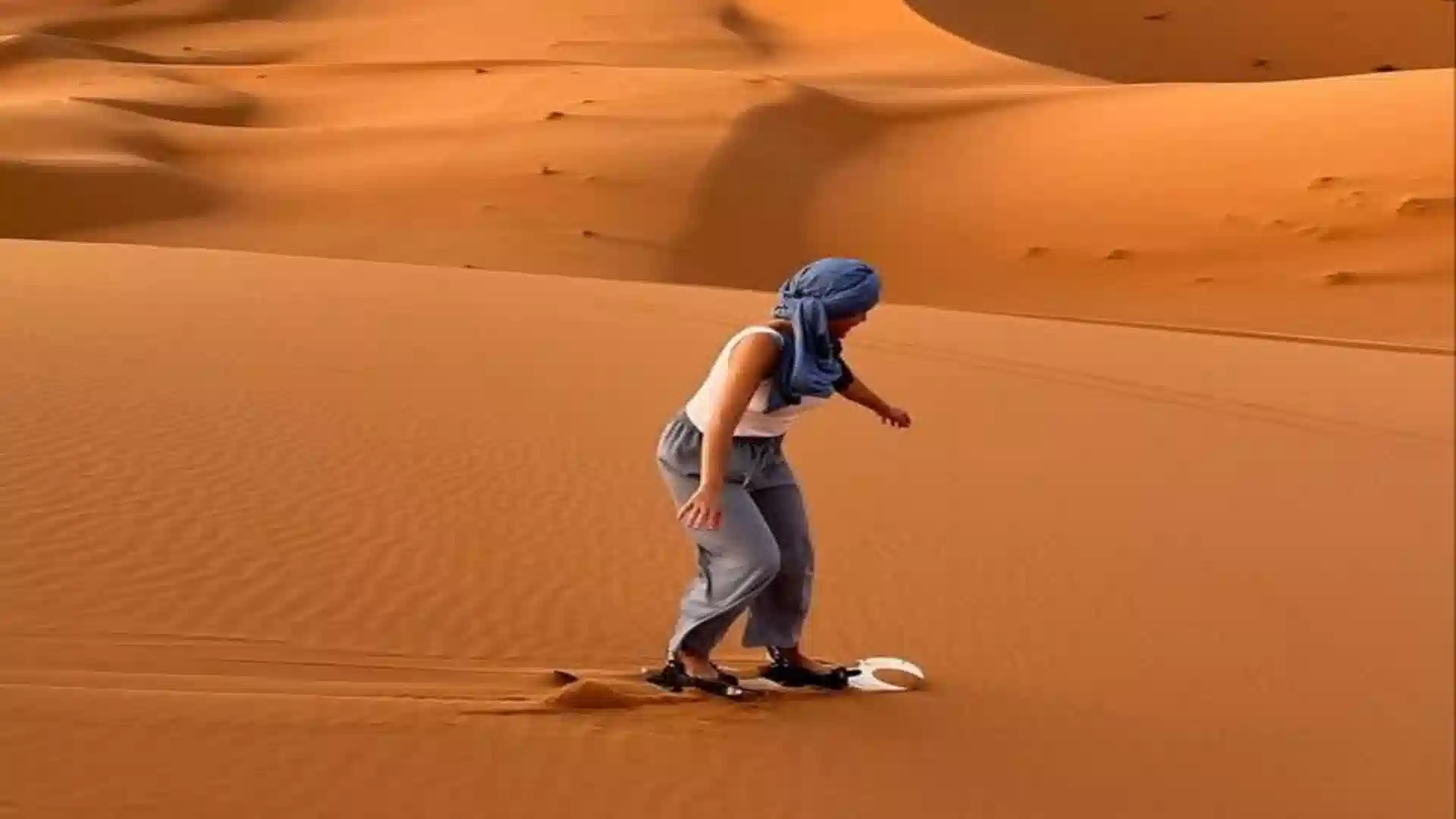
- Sandboarding: Rent a board at the camp and ride the dune faces near Merzouga village — no experience required, and the soft sand makes falls painless, so it’s an easy add-on even for families with kids.
- Quad biking or 4×4 excursion: A faster, more adrenaline-driven way to cover the dune fields and surrounding hammada (rocky desert), usually booked as a 1-to-2-hour add-on the afternoon you arrive.
- Khamlia village: A short drive from Merzouga, home to a Gnaoua community descended from Sub-Saharan trade routes, whose evening music performances — deep bass krakebs and call-and-response singing — are a genuinely different cultural note from the desert scenery itself.
- Stargazing: With almost no artificial light for miles, the Milky Way is visible to the naked eye on clear nights, especially October through April; many camps will point out constellations around the fire before you turn in.
- Fossil hunting near Erfoud: The region sits on an ancient seabed rich in trilobite and ammonite fossils, and several family-run workshops on the way into Merzouga let you see them cut and polished, with pieces available to buy directly from the people who prepared them.
Common Mistakes to Avoid on the Marrakech to Merzouga Trip
A handful of avoidable planning mistakes account for most of the disappointed reviews of this specific route. Watch for these before you book:
- Underestimating the drive. Nine to ten hours sounds manageable on paper, but combined with mountain switchbacks and stops, a single-day attempt leaves you exhausted and rushing through Ait Ben Haddou and the gorges. Build in at least one overnight each way unless you’re genuinely pressed for time.
- Packing only for daytime heat. Desert nights drop dramatically even when the day was scorching. Travelers who pack shorts and t-shirts only are consistently the ones shivering around the campfire.
- Booking the cheapest quote without checking inclusions. A rock-bottom 3-day price sometimes means an older vehicle, a shared camp with no bathroom access, or no licensed guide for the historical stops along the way. Compare what’s actually included, not just the headline number.
- Not confirming pickup and camp details in writing. Get your pickup time, vehicle type, and camp tier (standard vs. private tent) confirmed by email or WhatsApp before paying a deposit, not assumed from a verbal conversation.
- Skipping the gorges to “save time.” The Dades and Todra Gorges are genuinely worthwhile stops, not filler; cutting them to shave an hour off the drive is one of the more common regrets travelers mention afterward.
- Forgetting travel insurance. Mountain passes and desert roads occasionally see weather-related delays, particularly in winter. Insurance covering trip interruption and medical evacuation is inexpensive relative to the trip cost and worth carrying on a route this remote.
For the full activity list, including desert camp options and Dayet Srji’s flamingos, see our complete guide: Merzouga Morocco: The Complete Desert Guide.
What Is the Closest Desert to Marrakech?
Agafay is the closest desert to Marrakech at just 40 km (about 45 minutes), but it’s a rocky, hard-packed desert, not sand dunes — for the real Sahara, Zagora (360 km) is closer than Merzouga (560 km), though Merzouga has the taller, more dramatic dunes.
| Desert | Distance from Marrakech | Typical Trip Length | What You Get |
|---|---|---|---|
| Agafay | 40 km (~45 min) | Half-day or day trip | Rocky desert, hills and dry riverbeds — no sand dunes, but a quick “desert” experience close to the city |
| Zagora / Erg Chigaga | 360 km (~6–7 hrs) | 2–3 days | Real Sahara sand, the Draa Valley’s palm groves, generally fewer tourists than Merzouga |
| Merzouga / Erg Chebbi | 560 km (~9–10 hrs) | 2–4 days | Morocco’s tallest and most iconic dunes (up to 150m), the widest choice of desert camps |
If you only have an afternoon, Agafay is the honest answer to “closest desert to Marrakech” and makes a fine sunset camel ride or dinner-under-the-stars add-on — but don’t expect it to look like the Sahara photos that made you want to visit Morocco in the first place. Those photos are almost always Merzouga’s Erg Chebbi, or occasionally Zagora’s Erg Chigaga. For a full breakdown of Merzouga versus Zagora specifically, see Merzouga vs Zagora: Which Desert Tour Wins?
This is where a lot of first-time visitors get tripped up when they book online: a search for “desert tour from Marrakech” surfaces Agafay day trips, Zagora 2-day tours, and Merzouga 3-to-4-day tours side by side, often without making clear how different the actual landscapes are. If seeing genuine Sahara sand dunes is the goal — the reason most people put a desert stop on their Morocco itinerary in the first place — Agafay won’t deliver it regardless of how it’s marketed, and it’s worth choosing between Zagora and Merzouga instead based on how much time you have and how remote you want the experience to feel.
Best Time to Make the Marrakech to Merzouga Trip
March–May and October–November are the best months for the Marrakech to Merzouga trip, offering comfortable daytime temperatures in the desert and clear conditions over the Tizi n’Tichka pass. Summer (June–August) brings extreme desert heat, while winter (December–February) is pleasant by day but cold at night, so pack layers regardless of when you go. For a full month-by-month breakdown, see Best Time to Visit Merzouga Desert: Month-by-Month Guide.
Frequently Asked Questions
How do I get to Merzouga from Marrakech?
By road — it’s about 560 km and 9–10 hours of driving, almost always split into a 2-to-4-day guided tour with a private or shared 4×4, since no flight or train serves Merzouga directly. A CTM/Supratours bus plus local transfer is the budget alternative, but it takes 12+ hours and still requires a separate camel trek and camp booking once you arrive.
Is it worth visiting Merzouga?
Yes — Merzouga’s Erg Chebbi dunes are Morocco’s tallest and most iconic Sahara landscape, and the overnight camel trek and desert camp are consistently rated as the highlight of a Morocco trip. It’s a better fit for travelers with at least 5–6 total days in Morocco, since the round trip alone takes 2–3 days out of a shorter itinerary.
What is the closest airport to Merzouga, Morocco?
Errachidia Airport (ERH) is closest at about 126 km and a 2-hour drive, but Marrakech’s airport is far more practical due to its much higher flight frequency and international connections. Ouarzazate and Fes are the other regional options, though both have thinner schedules than Marrakech.
Can I plan a 2-day trip to Merzouga from Marrakech?
Yes, a 2-day trip is possible with one desert overnight, though it means two long driving days with little time at stops along the way; a 3-day trip is the better-reviewed option if your schedule allows it, since it splits the drive and adds real time at the Dades and Todra Gorges.
Is the Merzouga desert safe?
Yes, Merzouga is safe for tourists — the main considerations are environmental (extreme summer heat, cold desert nights) and choosing a licensed operator, rather than any significant crime risk. Staying with your guide and group after dark, rather than wandering the dunes alone, is the main practical precaution.
Plan Your Marrakech to Merzouga Trip with Over Morocco Tours
Whether you have 2 days or 5, we run the Marrakech-to-Merzouga route daily with licensed, English-speaking driver-guides, private and shared departures, and desert camps ranging from standard Berber tents to private luxury setups. Since we’re based in Merzouga ourselves, the route above — timings, stops, and honest tradeoffs — comes from the trip we actually run, not a desk estimate.
Every quote we send includes transport, accommodation, the camel trek, and desert camp meals clearly itemized, so you know exactly what you’re paying for before committing a deposit. Tell us your travel dates, group size, and how many days you have, and we’ll tell you honestly whether a 2-day, 3-day, or 4-day version fits best — rather than upselling you into a longer package than your schedule can comfortably support.
Our most-booked Marrakech to Merzouga tours:
- 3-Day Marrakech to Merzouga Desert Tour — the classic route with one desert night
- 4-Day Marrakech to Merzouga Desert Tour — a second desert night and more time at the gorges
- 5-Day Marrakech–Merzouga–Fes Circuit — combine the desert with Morocco’s imperial cities
Each of these can be booked as a shared small-group departure or built as a fully private tour, and every itinerary above can be shortened, extended, or adjusted for a 2-day version, an added rest day, or a one-way finish in Fes instead of a return to Marrakech.
Browse Our Merzouga Desert Tours →
Related Guides
- Merzouga Morocco: The Complete Desert Guide
- Merzouga vs Zagora: Which Desert Tour Wins?
- Morocco Desert Tour Cost: What You Actually Pay in 2026
- Is Morocco Safe to Visit in 2026?
- Best Time to Visit Merzouga Desert
Sources referenced: Morocco National Tourist Office and U.S. Department of State Travel Advisory for Morocco. Road conditions and drive times can vary seasonally; always confirm current conditions before making the Marrakech to Merzouga trip.